Advancing Boardroom Excellence: Insights on Audit Committee Effectiveness
Global risk and audit committee effectiveness were on the agenda when The Institute of Internal Auditors (The IIA) officially launched its Global Audit Committee Center, convening an influential group of chief audit executives, audit committee members, and other executives from around the world for an opening meeting. The Center is dedicated to offering thought leadership, strategic insights, and resources to help boards and audit committee members strengthen and advance governance excellence through their relationships with the internal audit function.
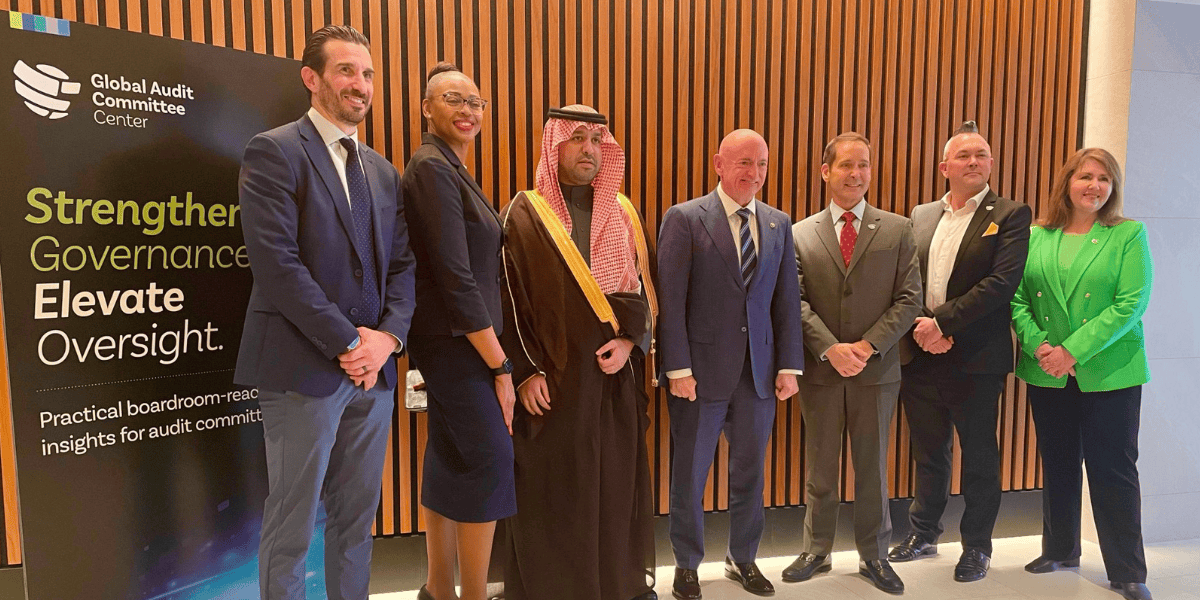
IIA Launches Global Audit Committee Center
The Institute of Internal Auditors launched its Global Audit Committee Center at an event in Washington, DC, highlighting how audit committees and internal audit work together to strengthen governance and oversee emerging risks.
The event featured two informative panels where business leaders discussed the global geopolitical risk landscape and audit committee effectiveness.
Audit Committee Observations on Global Risks and Talent Needs
Terry Grafenstine, immediate past chair of The IIA’s Global Board of Directors and chief audit executive with PenFed Credit Union, moderated the first panel, Navigating Global Risk Landscapes — Audit Committee Oversight in an Era of Geopolitical and Regulatory Complexity. Panelists included Abdullah Alharbi, partner at CLA (CliftonLarsonAllen) Saudi Arabia; Randy Clarke, CEO of the Washington Metropolitan Area Transit Authority; and Andrew Struthers-Kennedy, managing director and global lead, CAE Solutions, at Protiviti.
The panelists shared their observations about the changing environment, including:
- Geopolitical tensions are now a standing agenda item for audit committees, said Struthers-Kennedy. Despite its benefits, growing global interconnectedness — through supply chains and technology, for example — also drives new risks.
- Boards are demanding scenario planning and stress testing as standard tools to ensure ongoing organizational agility and resilience.
- Panelists emphasized that it’s a mistake to see risk as entirely negative. Organizations should also focus on the opportunities it can provide.
Mat Young, executive vice president, Global Advocacy, Policy & Stakeholder Relations at The IIA, moderated the second discussion, The Future of Audit Committee Effectiveness —Technology, Talent, and Transparency. Panelists included Ann Cohen, IIA chief financial officer and independent board member of Niagen Bioscience; Sarah Francis, global client service partner and managing director, EY Center for Board Matters; and Luke Wharton, Executive Search & Leadership partner at Spencer Stuart.
Insights from the panelists include:
- Audit committees are moving beyond using AI for basic productivity enhancement and are putting it to work in higher-value opportunities, such as scenario planning, predictive modeling, horizon scanning, reverse engineering, testing whole-population samples, and ideation on driving higher value in internal audit.
- Audit committees will have to ensure ethical use of emerging technologies, with clear governance frameworks that maintain transparency around data and identify bias.
- Boards and audit committees should engage in regular board and peer reviews, update their charter in light of the impact of AI and other emerging risks, and engage in timely succession planning. It is a good idea, as well, for audit committees to monitor and revisit risk appetite to ensure it remains relevant under current circumstances.
Practical Solutions: Insights for Audit Committees and CAEs
Panelists provided several other practical recommendations for audit committees and boards. For example, to enhance a proactive approach, audit committees need to think about shifting the bulk of their focus from oversight to foresight. According to Struthers-Kennedy, to monitor risks, audit committees need access to all areas of the organization, so that nothing is siloed.
In addressing top risks such as cybersecurity, anti-corruption, or privacy concerns, organizations should examine how consideration of each issue is embedded in corporate culture. And while organizational needs may vary based on a variety of factors, a common framework with local addenda can enable compliance across jurisdictions and ensure veracity of information.
Data should not simply be seen as something to be protected but should be recognized as an organizational asset. Because all business processes rely on data, audits should include data objectives. “Corporate governance will be looking at high-value opportunities to leverage data as a real asset,” Cohen told the group.
In considering which skills and experience are critical for audit committee members, panelists said it’s important to focus on mindset and the ability to apply knowledge to new challenges and address problems horizontally and vertically. An inclusive board and committee culture benefit companies given the value of diverse viewpoints in decision making, they added.
Audit committees should also benchmark their own AI adoption or maturity, the panelists said. Just as committees bring in subject-matter experts in cybersecurity or strategic planning, they should consider leveraging ethics expertise. As investors call for greater AI mission clarity and disclosures, audit committees can use AI for predictive analyses of shareholder votes.
Leveraging the Value of Internal Audit
Internal audit can use its knowledge and expertise to expand key performance indicators beyond risk management to provide advice on risk opportunity and strategy. Boards and audit committees should give internal audit and the organization space to experiment with AI within appropriate guardrails, panelists said.
Establishing a Global Board to Guide the Center’s Strategy
As part of its expanded focus on global governance, The IIA is establishing a Global Audit Committee Center Board of Directors, representing six regions: North America, Latin America, Europe, Africa, the Middle East, and Asia-Pacific. This board will guide the Center’s global strategy and ensure regional perspectives are reflected in its initiatives. The Board’s inaugural chair will be Abdullah Alshebeili, CEO of the Saudi Authority of Internal Auditors.
Anita Dennis is a freelance business writer based in the New York area.