00:00:02 The IIA
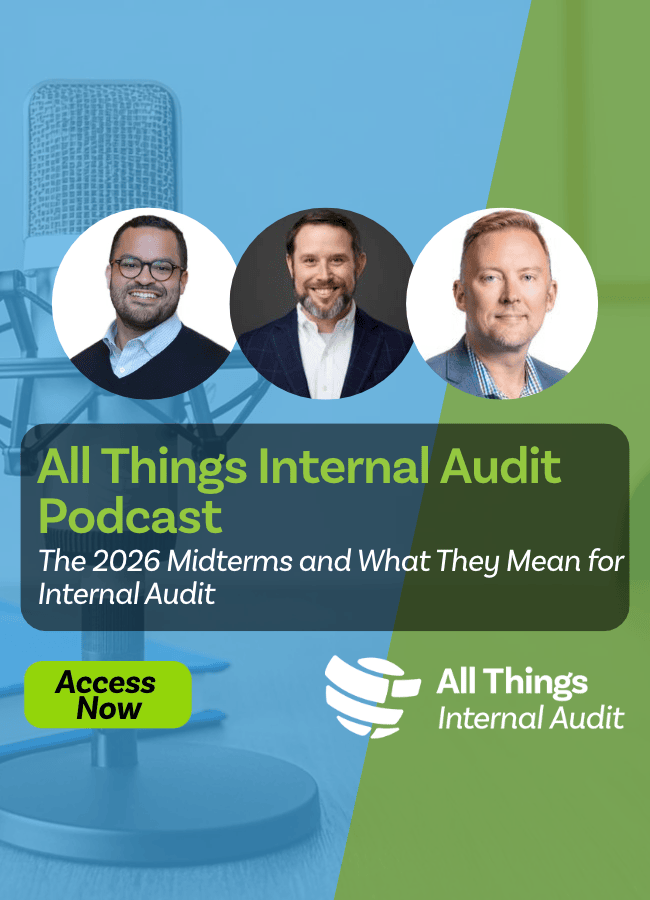
The Institute of Internal Auditors presents All Things Internal Audit. In this episode, Ramon Correa talks with Matt Young and Michael Downing about the impact of the 2026 US midterm elections on the internal audit profession. They discuss changes in Congress, the implications of divided government, and how shifting political priorities could influence regulatory oversight.
00:00:23 The IIA
and legislation. The conversation also explores the IIA's advocacy efforts surrounding corporate governance, cryptocurrency, artificial intelligence, and public sector accountability, along with opportunities for internal auditors in the new Congress.
00:00:39 Ramon Correa
Welcome everyone to All Things Internal Audit. I am Ramon Correa, Director of US Advocacy at the IIA. A lot has happened in this 2026 midterm cycle in the United States.
00:00:50 Ramon Correa
a lot of things, including changes in the composition of both chambers of Congress, the U.S. House and Senate. But what didn't change is the IIA's advocacy team's commitment to advocating for the profession. And today we'll talk about what happened, what it does and doesn't change, what it means for internal auditors. And I am joined by my colleague, Matt Young,
00:01:13 Ramon Correa
the IIA's Executive Vice President for Global Advocacy, Policy and Stakeholder Relations, and Michael Downing, our Vice President for North American Advocacy. And just to table set him before we get into the numbers, Matt, what is your first takeaway in A1 sentence about election night?
00:01:32 Mat Young
One sentence, I guess I would say voters were extremely unhappy and demanding that the government change direction.
00:01:41 Ramon Correa
What about you, Michael? Any high level?
00:01:43 Michael Downing
So again, I do think it's hard to distill it down to one sentence, but building off of what Matt said, we saw a lot of voter dissatisfaction, but what surprised me was the level of voter intensity that folks turned out in 2026.
00:02:00 Ramon Correa
So walk us through the results. Where do things stand as of today, November 13th?
00:02:07 Michael Downing
It's a moving target because many states are still, Alaska in particular, many House races. I think there's about a dozen House races that have yet to be called. But as things stand right now, the Senate has flipped to Democrats with a margin of 55 to 44. So Democrats flipped 8 Republican held seats.
00:02:30 Michael Downing
Some of the more notable switches include Ohio with the election of Sherrod Brown over Senator John Houston, Texas with the election of James Tallarico, Iowa, South Carolina, Mississippi, which was just recently called, a lot of traditionally red states or some of your more purple states.
00:02:52 Michael Downing
that have historically elected Republicans in this election went Democratic. On the House side, where I think there was already an expectation that Democrats were going to take the House, we saw much larger margins than anticipated. As of right now, we're looking at Democrats with a majority of just north of 250 seats.
00:03:19 Michael Downing
Republicans are at about 169 right now, which represents a total number of flipped seats of about 44 in the Democratic column, which is a pretty significant pendulum swing from where we were in the last Congress. And you know, as a result, you know, in my opinion, Matt, Ramon, curious your thoughts on this as well.
00:03:43 Michael Downing
But in many cases, at least at the House side, for Republicans, we saw a lot of members from the more moderate districts. So the Republicans that are more willing to make deals with Democrats, work on bipartisan issues, we saw a lot of them lose in this election. It's going to really change the composition of the Republican conference
00:04:08 Michael Downing
But curious, what your takeaway from that is, as the Republican caucus moves a little bit more to the right as a result of the loss of some of those members. Curious if you guys have any perspective on that as well.
00:04:23 Mat Young
I think that's right. Clearly, a lot of the moderates lost. And so what you're going to see is a far more partisan
00:04:32 Mat Young
dynamic between the Democrats and the Republicans. Also, anytime a party's in the minority, their ability, at least in the House, which is very much the majority, almost always gets its way, the role of the minority is often to throw bombs, to articulate an ideology, a viewpoint, a vision that they know has no chance of getting passed in the near term. And so you see that, I think, even in the election
00:04:56 Mat Young
as of Jim Jordan as the new leader for the Republicans. This is someone who is associated with the very far right part of the caucus, and he is probably not going to be one who's going to position himself often as a conciliator, as a centrist by any means. So I think your analysis is correct.
00:05:14 Ramon Correa
Yeah, and what I would add is in terms of the ideological composition of this
00:05:20 Ramon Correa
incoming Congress, I think we can see it as a matter of, in the spectrum of things, the center ideologically became wider in terms of numbers of members that we would consider more centrist, but then the polar ends went deeper. So we have a lot of more Republican members steering to your point, Michael, more to the right of things. But at the same time, we also are having a new crop of Democratic members that are really deep in the
00:05:50 Ramon Correa
left side of the political spectrum.
00:05:52 Mat Young
And I would just add to that, too. I think where you're likely to see a lot of infighting, a risk of infighting, will be in the Democratic caucus, because you have folks who are part of the Democratic Socialist part of the party, and then you have these very centrist moderates who won by less than 2% of the vote. And so there is room, a lot of common ground on some of the basic things, the war, tariffs, support for Obamacare, those types of things.
00:06:16 Mat Young
I think you'll see consensus, but over the longer run of this Congress, there's likely to be some ideological clashes that are going to be complicated for the speaker and the rest of the leadership to navigate.
00:06:28 Michael Downing
And one thing I would add, Ramon, building off of what you said and maybe segueing into a conversation about the governor's races,
00:06:37 Michael Downing
it looks like right now, and not all the races are called, but 13 states that President Trump carried in 2024 elected either a Democratic senator or governor in 2026. So I think that speaks to your point that the center is growing because there is always the possibility in electoral politics that in the next election, it could return to a more
00:07:04 Michael Downing
normal balance of partisanship. Voters come home to their respective parties. So it'll be interesting to see how these new senators and how these new governors are operating in states that are more traditionally conservative.
00:07:21 Ramon Correa
Yeah, and that's a great segue on taking a zoom into one of the states you mentioned earlier, Michael.
00:07:27 Ramon Correa
Iowa. There was a very interesting development at the governor level. One of those results is that of governor elect Rob Sand. Matt, do you have any insights into that election?
00:07:39 Mat Young
Yeah, I think for the internal audit community, this is actually one of the most exciting races of the cycle. For those who aren't familiar, Rob Sand, who was the state auditor,
00:07:50 Mat Young
ran for governor and won, won quite decisively, actually, won by about 10 points, and ran, I think, a very smart campaign. Our advocacy team has worked with Governor-elect Sand on a couple issues in the past. He's a very thoughtful, reasonable guy, and I think he's going to do an excellent job as governor. The fact that he won, I think partly he brought credibility as the state auditor, as someone who was going
00:08:16 Mat Young
to focus on good government and making things run well and effectively. But I also just say I have family in Iowa, so I followed the race particularly closely. I would hear things from my uncle and aunt and cousins. He ran in many ways a centrist. He talked a lot about not a red Iowa or a blue Iowa and trying to avoid traditional partisan framing. And I think that benefited him quite a lot too. So the profession
00:08:45 Mat Young
I think irrespective of where you fall in your own partisan leaning can celebrate that there is at least one state auditor rising to the governor's role in the country. And we already are hearing that Rob Sands, a Democrat, there's already at least one Republican state auditor who's planning to run in a different state for governor next year. So very excited to see these state auditors of both parties giving a try for the highest office in their state.
00:09:09 Ramon Correa
and in that same lane of state election races, a lot of movement also happened at the legislature level, at the state level. Any thoughts on that?
00:09:20 Mat Young
Absolutely. There are a number of state legislatures that flipped from Republican to Democratic this time. Obviously, we talked about the number of the governorships flipping
00:09:30 Mat Young
as well. The thing I would say for any profession, but for our profession, is that states really are central to setting a lot of policy that affects people's everyday lives. And so as you look at the debates that are happening, you're seeing conversations around AI, you're seeing conversations around cybersecurity. When you think about all of these states, they all have either a state auditor or a state comptroller. Many of them have robust internal audit functions within their governments. And so we're going to be watching
00:10:00 Mat Young
very closely when these new state legislatures convene in the new year to see what their policy agenda is. One of the things I'm really happy to share with our listeners today is that we are building out our advocacy function. For the first time, we're going to be building out a state advocacy program. So we're looking for ways to strategically engage in places where internal audit is part of that conversation.
00:10:25 Ramon Correa
definitely, especially when the adage still holds true that states are the laboratories of democracy. And we've seen that happening in a lot of the new emerging issues like AI, digital assets that the IIA has a lot of stake in. But Michael, going back to Congress and going back to DC, how does advocacy look like with this new lay of the land or with the incoming Congress? How does the IIA build those relationships with the
00:10:54 Ramon Correa
new lawmakers and their staff.
00:10:56 Michael Downing
You hit the nail on the head at the opening saying that in many ways our advocacy doesn't change. We continue to pursue a bipartisan agenda, building relationships with both sides of the aisle to talk about the issues that are important to internal audit, just like AI, cybersecurity, cryptocurrency, data privacy, all of these areas that we have been active in over the last couple of years.
00:11:22 Michael Downing
will remain our top priorities this year. But as we move into the new Congress, one thing that our team will be looking to do is assess who the new members are on the committees of relevant jurisdiction. So looking at the Senate Banking Committee, the House Financial Services Committee, in some cases, the oversight committees or energy and commerce. And we'll prioritize
00:11:46 Michael Downing
going into those offices, speaking with those staffs and those members. But in addition to what our team does, we have prioritized over the last couple of years building relationships at the grassroots level through things like the Congressional Key Person Program. For those of you who aren't familiar, this is an initiative that
00:12:08 Michael Downing
we run in partnership with our US chapters, where we work to get our chapter leaders in front of their local members of Congress back home in the districts. It's a great way to introduce the profession, provide some local context on the issues internal audit cares about and why they should pay attention to what we have to say. It really is an important compliment to the work that our team
00:12:34 Michael Downing
does in Washington. Another vehicle that we will continue to leverage as we move into the new Congress is our Political Action Committee, IIA PAC. This is a resource that allows our team to attend events across Washington where we can develop personal relationships with members of Congress and
00:12:57 Michael Downing
talk to them about the issues of importance to us and why internal audit should be involved in the conversation. And so that is based on the support of our US membership, but working in collaboration between our chapters, our members supporting IIA PAC and our team being proactive in our outreach on the Hill
00:13:22 Michael Downing
we'll continue building those relationships and talking about the issues of importance to the profession.
00:13:28 Ramon Correa
And a lot of those conversations, at least from my perspective and the conversations that I've been having with colleagues and inside and outside of the IIA, seem to assume that with the coming of new majorities or the coming of new compositions in Congress, that necessarily means that there's going to be a wave of new legislation
00:13:50 Ramon Correa
rulemaking, the enactment of a wave of new laws? Is that a safe assumption to make?
00:13:57 Michael Downing
I don't think so. I think that is a common misnomer, particularly as we confront a divided government situation where Republicans control the White House, Democrats control the Congress. I think on one hand, you are likely to see a lot of
00:14:15 Michael Downing
legislative activity among Democrats in Congress. But with a Republican president, most of that legislation is, particularly those that are more partisan, will see that get vetoed. But it takes two-thirds majority in the House and Senate to override a veto, which is a pretty difficult threshold
00:14:40 Michael Downing
to attain. Also in the Senate, it requires 60 votes to break a filibuster. So even though Democrats have a majority in the Senate, they are still going to have to rely on Republican votes to pass legislation, which becomes increasingly more difficult now that many of the centrists in the Republican conference
00:15:05 Michael Downing
have left, folks like Tom Tillis of North Carolina, Susan Collins of Maine who lost reelection, folks like Cynthia Lummis to some extent, who's been a leader on crypto policy in the Senate. So I think from a legislative standpoint, you may see a lot of activity, but that doesn't necessarily translate into enactment of law.
00:15:29 Michael Downing
On the regulatory side, I don't anticipate much of a change because the administration will still continue to oversee the process at organizations like the Securities and Exchange Commission, the PCAOB, the FDIC, Office of the Comptroller of the Currency. They will continue with the standard setting or regulatory agenda that they have
00:15:54 Michael Downing
conveyed over the last two years. But what will change is oversight of their activities. And so now that we will have a Democratic Congress, you will see more oversight hearings and more scrutiny on the actions of those regulators, particularly when it comes to confirmations. I know the president recently nominated some folks to the CFTC and the SEC.
00:16:22 Michael Downing
those folks are going to face a difficult time if they don't make it through this Congress.
00:16:29 Ramon Correa
Reframing this conversation then into the actual 120th Congress, this is one of the largest freshman classes in recent modern history, I think, is a right way to describe it. Let's talk about the IAA's policy priorities for this new Congress.
00:16:47 Ramon Correa
Especially, let's focus or start with the financial services space. This fall, the IA, for example, one of our biggest campaigns this year was leading the opposition against the New York Stock Exchange proposal to increase from one year to five years the required period under which the listed companies can have internal audit functions embedded into those companies.
00:17:10 Ramon Correa
Where does that matter under this, or how does that play in under this new fabric of Washington politics?
00:17:17 Michael Downing
You're spot on. That was one of the top priorities of US advocacy over the last couple of months, where we pushed back against the proposal from the New York Stock Exchange, working in collaboration with our members, our chapter leaders,
00:17:35 Michael Downing
but also a coalition of eight industry, risk management, good governance organizations who agreed that internal audit is a core corporate governance responsibility and it needs to be there from day one, not five years down the road. So I think on the legislative side, there is going to be
00:17:58 Michael Downing
a lot more scrutiny over proposals like that. The expected incoming chair of the Senate Banking Committee, Elizabeth Warren of Massachusetts, has been very vocal about transparency and accountability among corporations. She has already signaled that there will be a lot of oversight of those type of institutions
00:18:22 Michael Downing
Same on the House Financial Services Committee. I know there's still some campaigning over who will lead that body or that committee in the next Congress, but primarily they have largely agreed that there needs to be aggressive oversight of some of these organizations. So we anticipate that there will be greater scrutiny on proposals like this.
00:18:47 Michael Downing
but also taking a look at the SEC and their recent proposal to delay the accelerated filer status to five years for auditor attestations. That's also something that I think you're going to see them taking a deeper look into. Whether they can stop it, unlikely. Congress doesn't have that ability, but I think there's going to be a lot more scrutiny over these type of regulatory actions.
00:19:15 Ramon Correa
Matt, do you have any comments on that dynamic with the new composition of the Senate Banking Committee and the House Financial Services Committee?
00:19:23 Mat Young
What you're seeing fundamentally is the difference in the two parties, right? I think Republicans tend to have a more libertarian approach to some of these issues and Democrats believe in a more robust regulatory regime. And that's going to come to a head next year as the SEC moves through rulemaking to change some of these requirements for Sarbanes-Oxley and other requirements.
00:19:46 Mat Young
the Democrats are not going to be okay with that. And you're going to start to see oversight. You're going to start to see legislation introduced. You're going to see a new debate about what is the right level of oversight of requirements under the law. And so we should expect it to be, as Michael said, a very robust, interesting time, very robust debate, interesting time on the Hill, but the ability to actually enact legislation
00:20:09 Mat Young
when you have a president of a different party is pretty limited.
00:20:13 Mat Young
But what they can do, what the Democrats can do is shift the conversation, shift what's called the Overton window, the window of what's considered possible in politics back to the left a little bit and bring a spotlight on some of these issues.
00:20:26 Ramon Correa
Yeah, and crypto was one of those issues that we saw and closely tracked during this Congress.
00:20:34 Ramon Correa
Any comments or thoughts on how does the crypto
00:20:37 Ramon Correa
landscape move forward in the upcoming Congress next year.
00:20:41 Mat Young
Yeah, this is actually one of the more exciting areas for the profession where we had a big victory with the recently passed Genius Act, which was the first piece of legislation enacted by Congress that led to a set of regulations issued by the Office of the Comptroller of the Currency, the Federal Deposit Insurance Corporation and the Federal Reserve to effectively
00:21:02 Mat Young
require an internal audit for what are called stablecoin issuers.
00:21:07 Mat Young
And so this is a very important first step.
00:21:09 Mat Young
What it does is it says effectively that policymakers looked at this, they looked at the cryptocurrency industry, and they said, you know, we need a certain level of governance.
00:21:18 Mat Young
And one way that we solve that level of protect, we offer that level of protection for customers is through an internal audit function.
00:21:25 Mat Young
And so it's very exciting.
00:21:27 Mat Young
That laid the foundation for a separate crypto bill
00:21:31 Mat Young
which was pending this year that did not pass, where we also had internal audit mentioned in the proposals.
00:21:38 Mat Young
That bill, the crypto bill that went down earlier this year, is likely coming back next year.
00:21:44 Mat Young
But it's going to be a very, very different bill because as I was talking about the tension and views earlier, the bill that the Republicans predominantly wrote this year, although with a fair amount of Democratic consultation and negotiation,
00:21:58 Mat Young
this time it'll be the Democrats writing the bill with some Republican consultation and input.
00:22:03 Mat Young
And so we shall see what that bill looks like or if there's even an interest in moving it.
00:22:08 Mat Young
But if there is a bill introduced, and I suspect at least a bill will be introduced, I don't know if it'll get marked up, but you will likely see is a stronger emphasis on things like consumer protection, anti-money laundering safeguards.
00:22:19 Mat Young
I know that's been a particularly big interest
00:22:22 Mat Young
of Senator Warren, who's likely to be the next chair of Senate banking.
00:22:25 Mat Young
And that also should make it feasible for us to insert ourselves into the debate about the role of assurance expectations at these crypto companies.
00:22:33 Mat Young
I mean, it hasn't been that long since FTX.
00:22:36 Mat Young
And we all remember what happened there when they did not have really any governance risk compliance mechanisms in place, no assurance in the way that a company of that size with those kinds of risks should have.
00:22:49 Mat Young
So I'm very excited for the accomplishments that we've had so far.
00:22:53 Mat Young
And I think we're going to have an opportunity to continue to discuss crypto and discuss the role of internal audit next year.
00:23:00 Mat Young
And anytime these issues come up, whether it's crypto or it's AI or it's prediction markets, it's really just an excellent opportunity for us to get in front of policymakers and explain
00:23:09 Mat Young
the value of internal audit itself and the way that internal audit can effectively be a public policy solution in a whole host of different ways.
00:23:20 Ramon Correa
Yeah.
00:23:20 Ramon Correa
And crypto, one of the things we also monitor this year and will continue to happen in the next new Congress is this continued use of independent audit frameworks in these new and emerging policy spaces like crypto, but also in
00:23:37 Ramon Correa
AI.
00:23:38 Ramon Correa
For example, the Frontier Act would create an audit regime for advanced AI models.
00:23:43 Ramon Correa
Michael, do you have any thoughts on the Frontier Act and how does that look like for the 120th Congress?
00:23:50 Michael Downing
AI is one of those issues and I know we've all talked about it and our listeners are probably involved in it on a regular basis.
00:23:58 Michael Downing
How do you provide assurance over AI?
00:24:00 Michael Downing
It's certainly one of those topics that Congress knows it needs to address.
00:24:06 Michael Downing
but it doesn't quite know how to go about it.
00:24:09 Michael Downing
And so there have been a number of pieces of legislation introduced over the last two years around AI.
00:24:17 Michael Downing
In a lot of cases, it has really dealt with the technological or legal implications of AI.
00:24:26 Michael Downing
But within the last year, the Frontier Act, which is bipartisan legislation introduced by Congressman Jay Obernold
00:24:35 Michael Downing
a Republican of California, and Laurie Trahan, a Democrat of Massachusetts, has quickly gained consensus, so to speak, as one of the leading pieces of legislation to at least establish some type of framework for regulating AI.
00:24:56 Michael Downing
And as you said, Ramoni,
00:24:57 Michael Downing
primarily addresses the external audit piece of frontier AI models.
00:25:05 Michael Downing
It would establish a regime that would require periodic assessments from an independent verification organization, as well as robust internal controls.
00:25:19 Michael Downing
But beyond that, it is silent on how that internal
00:25:24 Michael Downing
mechanism is executed.
00:25:27 Michael Downing
And so we have been very active over the last couple of months in communicating with offices on the Frontier Act about the importance of having independent internal assurance to complement what the external assurance piece is looking to achieve.
00:25:44 Michael Downing
We recently submitted a letter to the sponsors of the legislation outlining our perspective on the bill.
00:25:52 Michael Downing
We provided some specific section by section amendments for their consideration.
00:25:58 Michael Downing
But one thing that we also think is important that needs to be included in this conversation
00:26:04 Michael Downing
is the role of the governing body.
00:26:06 Michael Downing
The Frontier Act is silent on the role of a government body in providing oversight of what management is doing.
00:26:15 Michael Downing
And audit committee work is something that we in IIA advocacy have been building out as well through our global audit committee center.
00:26:25 Michael Downing
And we want to make
00:26:26 Michael Downing
sure that boards have the resources they need to provide the effective oversight of their organizations.
00:26:34 Michael Downing
And so one piece that we argued for in the Frontier Act is recognition of what the role of the board is in receiving these reports and making sure they have all the information necessary to provide appropriate oversight of how AI is used and developed within their companies.
00:26:54 Ramon Correa
That's very interesting and you'll see how that develops in the new Congress with this new power dynamics in Washington.
00:27:01 Ramon Correa
But now taking a pivot to public sector auditing, Democrats have not been shy in telegraphing or not even telegraphing directly and outright saying that oversight and accountability will be central to their agenda and we can only
00:27:18 Ramon Correa
assume with a certain degree of certainty that inspector generals and the government accountability office will be taking a lot of headlines in the new Congress.
00:27:28 Ramon Correa
So for our listeners in the public sector auditing space, what should they expect from this new Congress?
00:27:36 Mat Young
Yeah, and one of the things that we have been following very closely is what is happening with the inspectors general and the GAO, the government
00:27:44 Mat Young
Accountability Office.
00:27:46 Mat Young
The term of the last Comptroller General ended many, many months ago, and there's been an acting Comptroller General.
00:27:54 Mat Young
And so one of the things that's actually being debated this week in the lame duck Congress is whether or not the president will try to move through a nominee for the Comptroller General position.
00:28:07 Mat Young
There's some question about whether or not they could get this through quickly enough before the end of the session, but there is discussion that a nominee could be put forward and move in the coming weeks.
00:28:18 Mat Young
We have taken the position in the past when the position became vacant, that it's really important that it be a nonpartisan position, that it be someone who is highly qualified.
00:28:29 Mat Young
And so we're willing to work obviously with both parties to make sure that there is a
00:28:34 Mat Young
high caliber person put into that role.
00:28:36 Mat Young
We also had some concerns at the beginning of the administration when a number of the inspectors general were fired.
00:28:42 Mat Young
It is the prerogative of the president to fire inspectors general, but there is a process that unfortunately wasn't followed.
00:28:49 Mat Young
And so at the time, we urged the administration to adhere to that process.
00:28:54 Mat Young
And so we're hoping that in this new environment,
00:28:57 Mat Young
that there is a careful understanding of the role that these people play in promoting public trust and ensuring that there's appropriate oversight of taxpayer dollars.
00:29:09 Mat Young
I do think on the congressional side, we are going to see quite a bit of ramping up of oversight hearings.
00:29:15 Mat Young
I think the chairman of the oversight committee in the House caused quite a stir on election night when it was clear the Democrats were going to win the majority by tweeting, quote, lawyer
00:29:26 Mat Young
up to the Republicans.
00:29:28 Mat Young
And so I think, again, oversight will be a very strong priority.
00:29:31 Mat Young
But at the same time, I do think the Democrats will have to balance how much oversight, how much sort of going, you know, what's seen as often as a political tactic going after folks will they do versus advancing legislation.
00:29:46 Mat Young
And they'll have to sort of walk and chew gum at the same time, if you will, by doing oversight, but also trying to put forward a proactive positive agenda that's going to resonate with voters.
00:29:56 Ramon Correa
Certainly a lot of activity to be seen and a lot of activity that is very relevant to the internal audit community.
00:30:02 Ramon Correa
But now looking to the road ahead and perhaps wrapping up, any last words for internal auditors and the IIA to take away from all of this conversation?
00:30:13 Ramon Correa
What does the road ahead look like?
00:30:15 Michael Downing
The next couple weeks will, I think, be telling.
00:30:19 Michael Downing
Congress is currently in the lame duck session.
00:30:23 Michael Downing
So there's a number of
00:30:25 Michael Downing
must pass pieces of legislation that they're working on right now, like the National Defense Authorization Act, nominations, as we've talked about.
00:30:36 Michael Downing
Once that work concludes and the next Congress begins on January 3rd, I think as we've talked about, you're likely to see a lot of gridlock based on the divided government that we're about to enter.
00:30:51 Michael Downing
But I think within that, there are still a lot of opportunities
00:30:54 Michael Downing
for the internal audit profession.
00:30:56 Michael Downing
A lot of the issues that we have discussed over the last couple of years are some of the more bipartisan topics that both sides of the aisle understand need to be addressed and have been willing to work together on finding a solution on those topics.
00:31:15 Michael Downing
And so I think while all of the noise is happening,
00:31:19 Michael Downing
next year, under the surface, there's going to be work getting done.
00:31:24 Michael Downing
And I think we have positioned ourselves well as a profession to be involved in those discussions and to provide technical resources as Congress looks to advance the Frontier Act, updated cryptocurrency legislation, potential data privacy legislation.
00:31:43 Michael Downing
We have built those relationships in partnership with our chapters over the last
00:31:48 Michael Downing
few years.
00:31:49 Michael Downing
And I think the road ahead looks promising in the new Congress, and I'm excited to see what happens.
00:31:54 Mat Young
Let me just echo what Michael was saying.
00:31:57 Mat Young
I think we spend a lot of time committed to approaching advocacy in a nonpartisan way.
00:32:04 Mat Young
We have allies on both sides of the aisle.
00:32:06 Mat Young
We do bipartisan outreach.
00:32:08 Mat Young
And while we lost some of our champions on the Republican side,
00:32:13 Mat Young
we still have some of our champions on the Democratic side who are now coming into new positions of power that they never had before.
00:32:19 Mat Young
And so we prepare no matter what the outcome, Democrats are in power, Republicans are in power, because we're internal auditing, good internal auditing policy is not a partisan issue.
00:32:30 Mat Young
And so as Michael said, I'm very excited because I think we'll see a lot of opportunities to discuss the value of internal audit, its role in all of these topics, AI, cyber data
00:32:39 Mat Young
privacy, prediction markets, good governance, and we'll be ready for it.
00:32:43 Mat Young
And so it will be a really interesting, I will say even fun time for the team to be up there on the Hill talking to regulators to try to advance the interests of the profession.
00:32:53 Ramon Correa
Interesting times indeed.
00:32:55 Ramon Correa
Lots of work.
00:32:56 Ramon Correa
The mission is still the same, advancing the best interests of the profession.
00:33:00 Ramon Correa
Thank you both for taking the time to having this timely conversation and thanks to everybody listening.
00:33:06 Ramon Correa
to those that are interested in all things internal audit and politics and Washington, D.C.
00:33:12 Ramon Correa
If you have any questions about anything we covered today, please feel free to reach out to the IIA's advocacy team.
00:33:18 Ramon Correa
And you can do that by writing an e-mail to the advocacy at viia.org.
00:33:24 Ramon Correa
And until next time, thank you both.
00:33:26 Mat Young
Thank you for having us.
00:33:28 Michael Downing
Thanks for having us.
00:33:30 The IIA
If you like this podcast, please subscribe and rate us.
00:33:33 The IIA
You can subscribe wherever you get your podcasts.
00:33:35 The IIA
You can also catch other episodes on YouTube or at theiia.org.
00:33:40 The IIA
That's T-H-E-I-I-A.org.