Global Internal Audit Standards
Global Internal Audit Standards™ guide the worldwide professional practice of internal auditing and serve as a basis for evaluating and elevating the quality of the internal audit function.
- The complete 2024 Global Internal Audit Standards are a mandatory component of the International Professional Practices Framework® (IPPF®).
- All internal audit functions are expected to be in conformance with the Global Internal Audit Standards.
Global standards for internal auditing
The Global Internal Audit Standards are set according to a due process followed by the International Internal Audit Standards Board and overseen by the IPPF Oversight Council.
Global Internal Audit Standards are also referred to as the Standards.
How are the Global Internal Audit Standards organized?
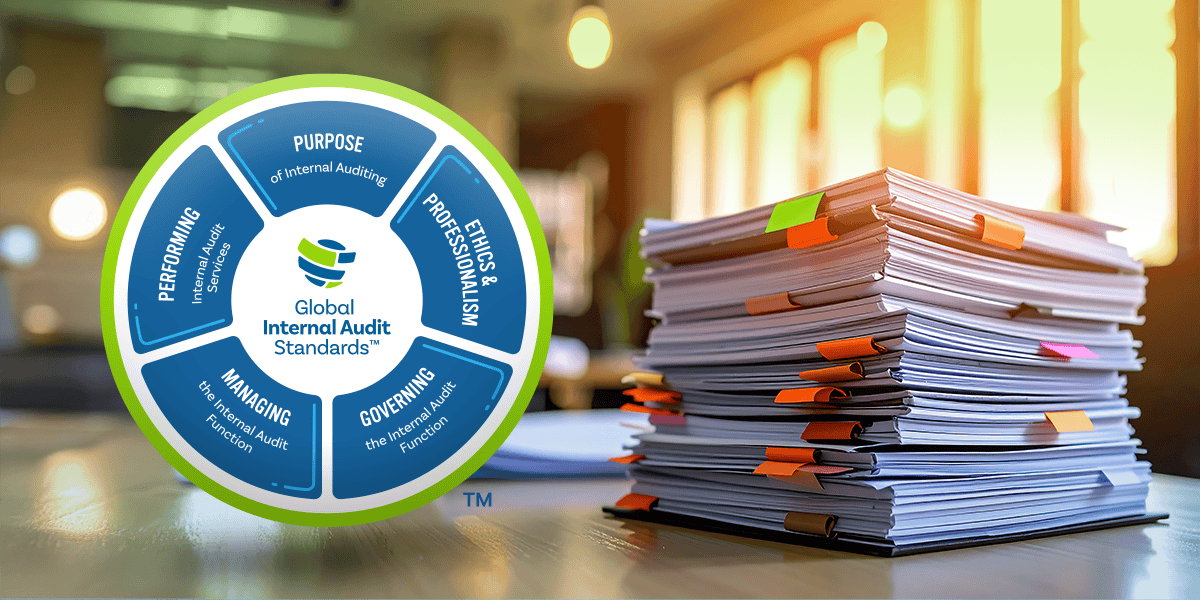
The Global Internal Audit Standards are organized into five domains: Purpose of Internal Auditing, Ethics and Professionalism, Governing the Internal Audit Function, Managing the Internal Audit Function, and Performing Internal Audit Services.
What are the principles of the Global Internal Audit Standards?
- The principles capture the essence of and provide the foundation for effective internal auditing.
- Each principle is supported by standards that contain requirements, considerations for implementation, and examples of evidence of conformance.
- Together, these elements help internal auditors achieve the principles and fulfill the purpose of internal auditing.
The 15 principles of the Global Internal Audit Standards
- Demonstrate Integrity
- Maintain Objectivity
- Demonstrate Competency
- Exercise Due Professional Care
- Maintain Confidentiality
- Authorized by the Board
- Positioned Independently
- Overseen by the Board
- Plan Strategically
- Manage Resources
- Communicate Effectively
- Enhance Quality
- Plan Engagements Effectively
- Conduct Engagement Work
- Communicate Engagement Results and Monitor Action Plans
Global Internal Audit Standards, 2024 Edition
The IIA Global Internal Audit Standards™, The Redbook™, guides the worldwide professional practice of internal auditing and serves as a basis for evaluating and elevating the quality of the internal audit function. Available as an eBook and hardcover.
Acknowledgements
The IIA is grateful to members of the International Internal Audit Standards Board past and present who devoted countless hours of their time as volunteers to this worthy project. The Global Internal Audit Standards are the culmination of years of research, outreach, feedback, and due diligence, all of which were vital to crafting Standards that reflect the vision, breadth, and depth of our profession and the needs of the organizations we serve. The IIASB thanks the IPPF Oversight Council, IIA members and staff, IIA affiliates, internal audit practitioners, and other stakeholders that contributed their time and feedback throughout the process. The perspectives shared were invaluable in shaping the Standards to address the evolving needs and challenges faced by audit professionals and organizations worldwide.